
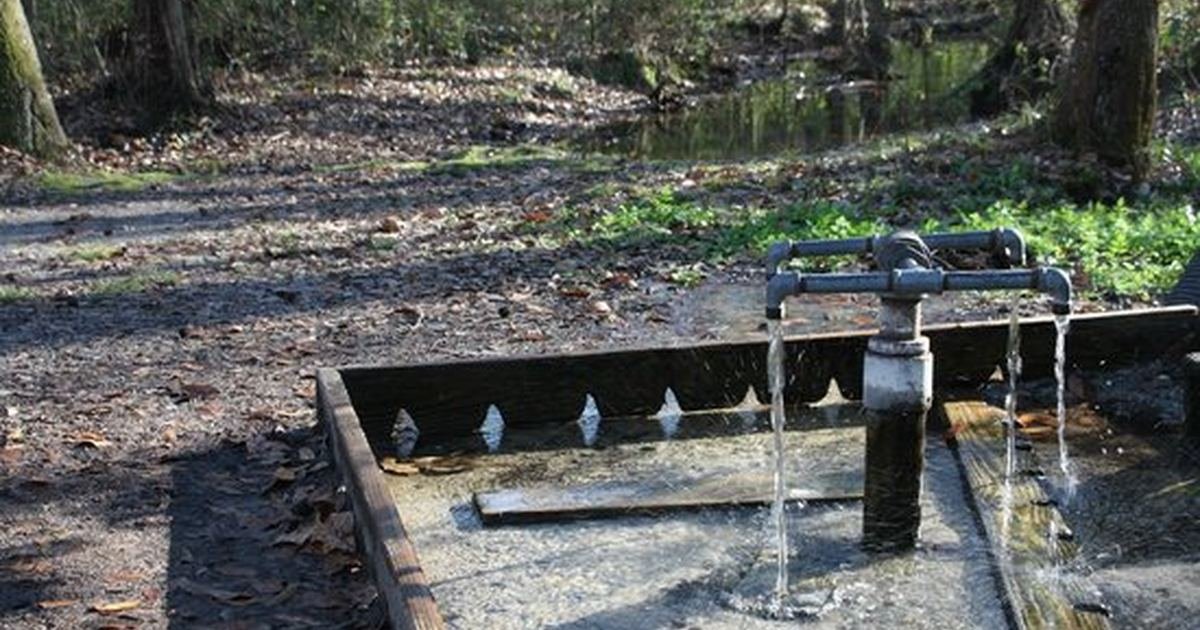
God’s Acre Healing Springs is a small public spring stop just outside Blackville, South Carolina. It makes sense as a short detour from Springfield for travelers interested in local history and the natural springs of the Sandhills. The site’s story comes from two different kinds of evidence. A local marker tells a Revolutionary War legend, and regional tourism material documents a landowner’s unusual decision in 1944.
Where to find Healing Springs near Blackville
Search for God’s Acre Healing Springs, Springs Court, Blackville, SC 29817. The springs are in Barnwell County, outside downtown Blackville. The regional tourism office lists daylight access. Save the specific map pin before you set out from Springfield. A search for “Healing Springs” alone can bring up the nearby country store and church as well as the spring.
Set your navigation to the springs and keep the other stops as separate pins. The approach takes you by a residential and church area. Use designated parking and keep space clear for other visitors. On a busy day, people collecting water may be making a routine stop. Give them room at the outlets and take photographs from a place where people can still walk past.
How the spring got its name
The local marker tells of wounded men who recovered after being brought to the springs during the Revolutionary War. The account is a local tradition passed down in the area. Its details vary in retellings, and the marker is a record of how the community chose to tell the story in 1998. Treat the healing claim as part of the story of the name.
In 1944, landowner L.P. “Lute” Boylston deeded the springs and surrounding land to God, according to Thoroughbred Country’s account. The name God’s Acre reflects that dedication. The deed story explains why generations of visitors have connected the site with public access and stewardship. The historical marker puts the story in one place, so reading it at the site adds more to a visit than simply stopping for a photo.
What you are looking at when the water flows
South Carolina’s Department of Environmental Services describes Healing Springs as a natural water source used by visitors and overseen by the state. A spring occurs where groundwater reaches the surface. At God’s Acre, pipes direct the flow to a spot where people can reach it. The steady flow makes the geology visible even if you stay for only a few minutes.
Follow current notices from the site or the state regarding the water. The spring’s historical name and the appearance of the water are separate from any current public-health guidance. If you are using this as a travel stop, bring water for the trip and plan facilities at a staffed location elsewhere if you need them.
Plan the visit around one nearby stop
| If you want | Pair the springs with | What to confirm |
|---|---|---|
| A quick return to Springfield | A brief stop to read the marker and view the springs | Daylight and any access notices |
| A town and history outing | Downtown Blackville | Hours for the museum, shop or restaurant you choose |
| A longer outdoor visit | Barnwell State Park near Blackville | Park hours, trail conditions and any lake notices |
Start with the activity that has the shortest access window. If you have a confirmed museum appointment or lunch reservation in Blackville, put the spring on the more flexible side of that stop. For a park day, check the park gate hours and do your longer walk earlier. Allow enough daylight for the springs if they come later. This keeps the short visit from delaying the activity you planned the day around.
What to bring and how long to allow
Wear shoes that can handle a damp surface near the outlets. Keep children close on the approach and leave enough room for people carrying containers. If someone in your group has limited mobility, ask the tourism office about the current parking-to-spring approach before relying on it. The site is compact, but waiting for the water area to clear or reading the marker can add time. Build that flexibility into the visit rather than aiming for an exact stop length.
From Springfield, the stop fits the area’s history of settlement between waterways. Continue reading about that geography in the Springfield history guide, or use the Springfield day-trip guide to plan the rest of your route.
The 1998 marker and the state’s springs page tell different parts of the story. Read the marker for the names, dates and events the historical society wanted visitors to remember. Use the state page to understand what a spring is and how South Carolina catalogs similar places. If you are researching the site for a class, identify which source supports each detail and describe the Revolutionary War story as local tradition.
Sources and access information
- Thoroughbred Country visitor information and historical marker text
- South Carolina Department of Environmental Services springs overview
- Town of Blackville visitor information
Featured photo by Kilodawg06 via Wikimedia Commons. CC BY-SA 4.0. Cropped and resized.